
Your AI knows the past. Let it see the future.
Credence is a probability API that lets AI agents reason responsibly about the future.
A real decision
Four days before the 2026 Eurovision final, Claude said I should book a venue for my Denmark watch party. Claude + Credence said the evidence was too thin to book. Denmark finished 7th.
See what happenedYour AI agent has an incomplete view of the future.
Ask your AI to reason about the future and at best it will anchor its views with a prediction-market price — a traded number shaped by fees, liquidity, and trader mix — reported as if it were the real probability, with no measure of how much to trust it.
Credence serves corrected probabilities and evidence strength of “Will X happen?” — so AIs can make better forward-looking decisions for their humans.
One Probability Object. Decision-grade.
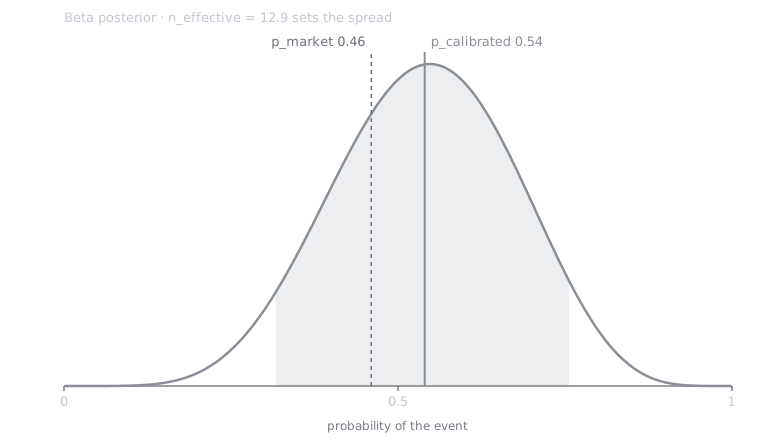
Three numbers that reconstruct the full distribution.
AIs ask “How likely is event X?” Credence returns our calibrated probability and evidence strength (along with the raw market price) — enough to reconstruct the full distribution. This unleashes your AI to do a wide range of probabilistic reasoning about the future.
- p_calibrated — our refined probability.
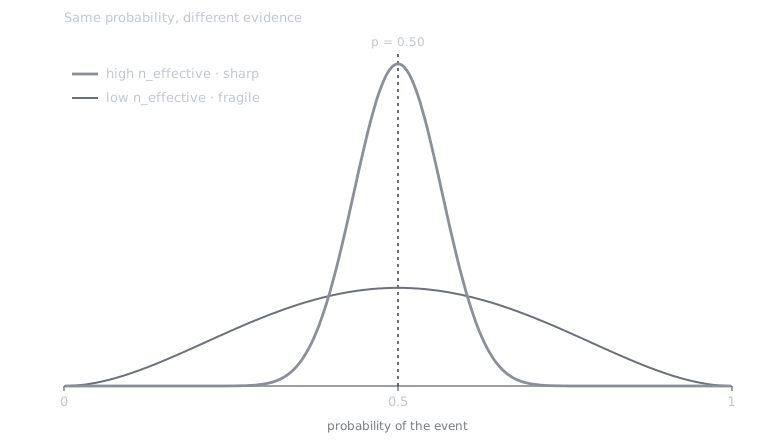
- n_effective — evidence strength: how much reliable market evidence stands behind the calibrated probability.
- p_market — the raw prediction-market midpoint.
Three pillars.
Calibration
Refined probabilities of future events, not just market prices.
Evidence Strength
An evidence-strength parameter on every probability, so you know when to trust it, and when not to.
Lineage
Audit-grade source provenance on every response; each number traces to the snapshot, model bundle, and inputs that produced it.
Markets contain opaque predictive information.
We serve it cleanly.
Markets are outstanding aggregators of predictive information, but AIs lose a lot of information looking only at prices.
We extract the distributions markets imply, calibrate them, and attach the evidence strength that markets don’t publish.
Built for AI agents first.
Machine-readable by default, with a clean human view on top — for AI agents and anyone who reasons about what happens next.
Integrates in 2 minutes with all major AI providers via MCP: Anthropic, OpenAI, Gemini, Copilot, AWS, Grok, and more.
Methodology you can audit.
Training is done using walk-forward, out-of-fold backtesting — contamination-safe by construction, never fit to its own test data.
Models promoted through formal gates with signed, versioned model bundles, reproducible by digest: every probability object traces back to the model and inputs that produced it.
Built by Jeffrey A. Ryan — Ph.D. in probability (NYU Courant), former US SEC machine-learning lead, former high-frequency trader.